Precision That Standard HVAC Contractors Don't Have
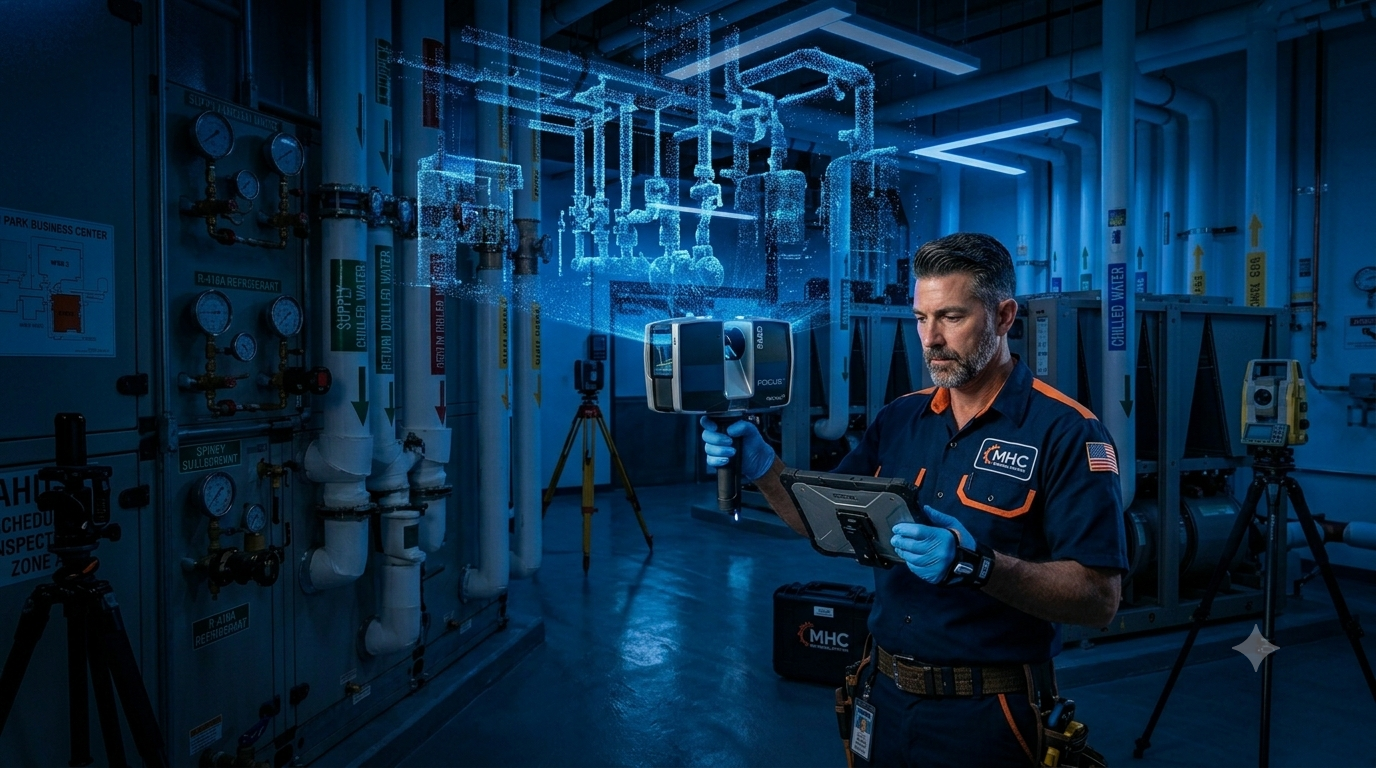
Most commercial HVAC contractors design systems from 2D blueprints and field estimates. We deploy advanced 3D spatial scanning technology — the same category of tooling used in aerospace manufacturing, autonomous vehicle development, and precision construction — to model your facility before we design a single duct run.
The result is an HVAC system engineered for your exact building — its actual walls, ceilings, thermal mass, occupancy zones, and airflow patterns — not a generic template applied to a floor plan.
Millimeter-Accuracy Facility Mapping
We capture the true geometry of every room, corridor, mechanical space, and plenum — eliminating the measurement errors that cause duct routing failures and airflow dead zones.
Thermal Zone Modeling
We identify how heat loads, solar gain, occupancy patterns, and existing ductwork interact — before installation begins — so we engineer around real conditions, not assumed ones.
Zero Re-Work Guarantee
When installation is guided by a complete 3D model, there are no surprises on site. Our clients don't get callbacks, change orders, or hot wings that the design "didn't account for."